
Not Consumed
"I therefore decided to give attention to the holy scriptures [. . . ] And this is what met
me: something neither open to the proud nor laid bare to mere children [. . .]"
St. Augustine's Confessions (397-400)
Points
for Reflection
The Bible: Genesis 4:1-16
- Does God appear to be privileging one form of husbandry over the other--shepherding animals over raising crops, or is there another explanation for why He is more pleased with Abel's sacrifice than with Cain's (v.1-5)?
- Verses 6-7 of chapter four anthropomorphize sin as a creature/being that/who crouches at the door of the individual's heart when the individual has not done what is right (a sin of "omission"), a problem apparently commensurate with more active, problematic behavior. What does this scenario suggest about the nature of morality?
- When asked where his brother is by a God who obviously knows the answer, Cain responds, "I don't know [. . .] Am I my brother's keeper?" What seems to be the answer to this question? Does The Bible as a whole appear to hold humans accountable only for themselves, or for others too?
- Was the punishment inflicted on Cain by God merciful (4:8-16)?
The Bible: 2 Samuel 11:1-12:25
- Why does David ask Uriah to return to his home and "wash his feet" (1:8), and why does Uriah refuse the king's request (1:11)?
- What lies behind David's successful attempt to get Uriah drunk (1:13)?
- How subtle is David's strategy to get rid of Uriah (1:14-25)? Do you think anyone other than Joab and the messenger will be able to figure out what David is doing? If so, might anyone guess why he's doing it?
- Does the narrative contained within chapter eleven of 2 Samuel lack details of character, setting, and psychology necessary to make sense of it? Does it include any extraneous details?
- Why does Nathan, the prophet, tell a parable to David (12: 2-4) before delivering his pointed accusation?
- Is Nathan overstating things when he accuses David of striking down Uriah himself (12:9)?
- What array of events will occur as a consequence of David's sin (12:10, 11-12, 14)? Does the punishment seem equal to the crime?
- Why does David fast (refrain from eating) and lie on the ground in sackcloth prior to the death of his young son, but not following the death itself (12:14-23)? Does his behavior seem logical or illogical? Upon what premise does his behavior rest?
- Does God appear to forgive David (12:13, 24-25)?
- Do you think the obvious moral embedded in this tale should be applied only to cases of murder and adultery?
The Bible: Job 23, 24, & 31:1-22
- Job, described only as a man living in the land of Uz who fears God, shuns evil, and does his best to sacrifice offerings for his children to counter their sins. He suffers the loss of his wealth and family because, apparently, Satan asks God for permission to test Job's faith (Job 1:1-19). Most of the Book of Job is about Job's grieving process, his questioning of God, and his friends' attempts to help him understand why he is suffering. In all of this, we are told, "Job did not sin or charge God with wrongdoing" (1:22 NIV). Do you agree, or find in chapters 23, 24, or 31 anything that sounds like sin?
- For what array of reasons does Job wish that God were more like a human judge (23:1-7)?
- What consequence does Job anticipate if he holds fast to his belief and devotion (23:10)?
- Can 23:12 be reconciled with Abraham Maslow's hierarchy of needs?
- Track the conjunctions used at the beginning of new statements as we move through verses 10-17, from "But" (v.10) to "But" (v.13) to "For" (v.14) to "Therefore" (v.15) to "Yet" (v.17). Is the train of Job's thoughts about God best described as confused, confrontational, complex, or something else?
- Does Job imply in 24:1 that knowledge requires sight? Can knowledge of God comfortably do without sight?
- Do you find it difficult to distinguish between which verses in Job 24:1-17 refer back to those who know God (v.1) and those who injure others (v.2)?
- While enumerating the apparent injustice of a world in which the impoverished receive little outside assistance, Job notes that the poor must glean (i.e. pick up post-harvest leftovers) "the vineyard of the wicked man" (24:6) and make oil "among the olive rows of the wicked" (24:11). How is "wicked" implicitly defined in these passages?
- Does Job 24:12B ("yet God charges no one with wrong," ESV) sound like matter-of-fact recognition of an uncomfortable truth, or an accusation?
- In what way are metaphorical and literal conceptions of light related here (24:13-17)?
- Notice the shift in voice signaled by single quotation marks in verses 24:18-20, during which time Job ventriloquizes the voice/perspective of his friends who are trying to explain why he is suffering. What is Job's point? What idea have his friends asserted, a notion which Job is intent on refuting?
- Bible translators differ on whether the subject of 24:22, the Hebrew for "he," should here be interpreted as "God" (as in the ESV) or as a reference to a ruler whose wicked behavior places him alongside those whose selfish actions were just detailed in verses 18-21. How do these two different interpretive options alter the meaning of the verses which follow (24:23-24)? Are these different interpretations mutually exclusive, or can they coexist?
- What multifarious consequences does Job enumerate as possible results of failing to control the heterosexual male gaze (31:1-10)? What do you think Job means when he claims to have "made a covenant with [his] eyes" (31:1, ESV)?
- Does Job live according to an egalitarian ethos, or does he reinscribe the dominant social hierarchy which considers servants as lesser than their masters (Job 31:13:-15)?
- Are those who are most vulnerable in ancient Hebrew society (21:16-21) akin to the vulnerable and disenfranchised in our own time & clime?
- What punishment does Job prescribe for himself if his friends' accusations against his virtue are accurate (31:21-22)?
The Bible: Song of Songs (Song of Solomon), chps. 1-8
- Is there a clear, traceable chronological structure that binds together the events of this book? Is it inappropriate to string together the lover's disappearance in 5:6, his being discovered among the lilies (6:2-3), and his wandering about the vines and pomegranates in 5:11-12? Do these feel like "events" in a narrative, or loosely interrelated vignettes?
- Should Song of Songs shape the way its readers think about beauty in aspects of human experience besides the sexual?
- Does either the man or the woman control the discourse of desire? What similes and metaphors do they each use to describe one another, and what do these comparisons suggest about the nature of their relationship?
- Is the woman in this romance as relationally proactive as her male lover?
- What about the woman's appearance earns the stares of her female peers?
- Do we fault the male lover for telling his beloved "there is no flaw in you" (4:7), for claiming that she is physically perfect?
- Why does the man compare his lover to a "garden locked up" and "a spring enclosed" (4.12), and what is his beloved's response to these metaphors?
- Assuming that only one male lover is present in this poem (some scholars suggest two), does the realization that the male lover has access to sixty queens, eighty concubines, and "virgins beyond number" (6:8) disrupt the romantic atmosphere of this poem?
- Do the sexual double entendres in this poem seem inappropriate for a book of The Bible?
- In 1 Peter 3:1-6 (located in the New Testament), Peter discourages Christian women from wearing jewelry, arguing that inner beauty of character should radiate outwards, making such artificial adornments unnecessary. What is this poem's attitude towards jewelry?
- Why might the poet identify such seemingly inconsequential details as the type of woods out of which the lovers' house is made (1:17), and the season in which these events occur (2:11-13)?
- Do these lovers extol one another's beauty, in part, by comparing their beloved's appearance to that of others of the same sex?
- Why might the female narrator repeatedly warn her friends, "Do not arouse or awaken love until it so desires" (2:7, 3:5, 8:4), and what does she mean by these words?
- Why does the man call his beloved “sister” (5:1, etc.) and why does the woman briefly wish her lover were "like a brother, who was nursed at my mother's breasts" (8:1)?
- Why do these lovers, in the midst of their verbal lovemaking, keep on mentioning their parents?
- Which metaphors and similes used to describe male and female beauty seem most effective? Could any of them be used today too?
The Bible: Lamentations 3:16-40
- The Book of Lamentations expresses deep sorrow at the destruction of Jerusalem by the Chaldeans (Babylonians) in 586 B.C., and identifies God as an active, not passive, agent in the suffering of the grieving Israelites. Does the Lord God appear as a villain, disciplining parent, puppeteer, gamemaster, or something else?
- In what ways does the speaker feel he has been permanently changed by his suffering (3:17-18)?
- Is the speaker gaming his own mind by expressing grief and hope virtually simultaneously (3:16-17, 21-23), or is it actually possible to hold onto sustaining hope while still in the depths of despair?
- The speaker notes it is "good that one should wait quietly / for the salvation of the Lord" (v.26; see also 3:28-29). Is he himself incapable of what he is recommending, or does the genre itself require that he express what should not, apparently, be expressed?
- What about God's character and mode of discipline brings the writer hope (3:22-23, 31-33)?
- Does the writer appear convinced that the suffering of his people is undeserved (3.38-40)?
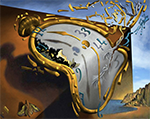
Soft Watch at the Moment of First Explosion (1954)
oil on canvas
Salvador Dali
Dr. Paul Marchbanks
pmarchba@calpoly.edu


